What is forging and why it outperforms casting
A freshly cast steel ingot is, by its very nature, a raw material: it has a coarse crystalline structure and possible micro-porosity concentrated along its central axis. It’s a solid starting point, but not yet a component ready for critical applications.
This is where forging comes in. Through a sequence of compressive deformations, the material is brought to its maximum plasticity and reshaped: the coarse crystalline structure refines into a fine grain, internal discontinuities are closed, and the piece gains uniform compactness throughout its entire volume. This is the fundamental difference from casting: a cast part retains the original structure of the pour, while a forged part is physically “worked” until it achieves superior mechanical properties in terms of strength and toughness — properties that are especially critical where the margin for error is minimal.
It’s no coincidence that the highest-criticality sectors, from energy to Oil & Gas, have always favored forged components over cast ones: plastic deformation of the metal is not just a matter of shape, but a genuine structural treatment that makes the part more reliable over time and more predictable under stress.
The process stages at Metalcam
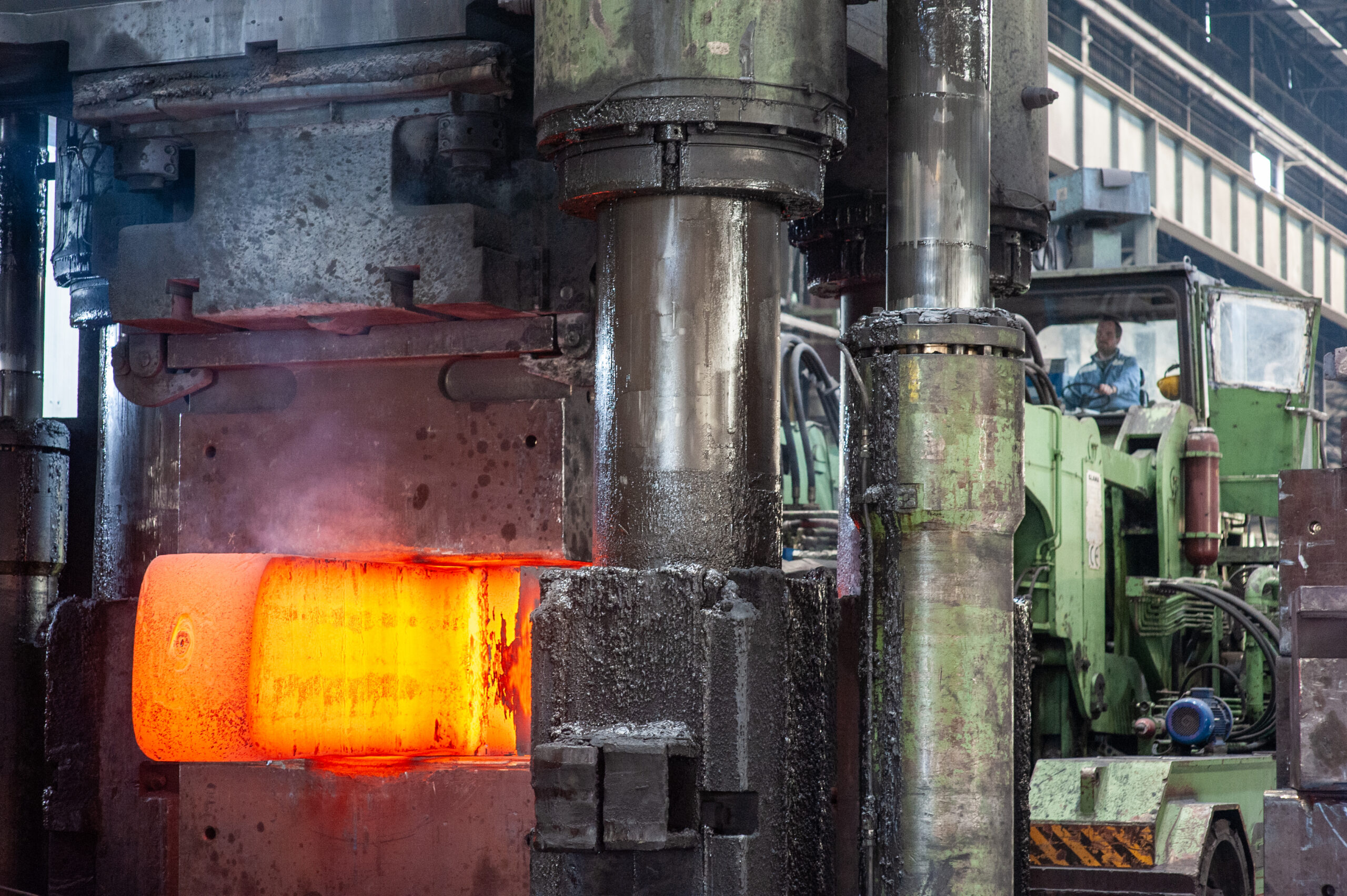
At Metalcam, the process begins with ingots produced in-house at our own steel mill, allowed to cool completely and then reloaded into the heating furnaces of the forging department, where they reach the ideal forging temperature of 1200–1250°C: the threshold at which steel achieves maximum workability. The department is equipped with a battery of gas-fired mobile-hearth furnaces, up to 13 meters in length, sized to handle ingots of widely varying weights and dimensions, in line with the custom-made production that characterizes the entire Metalcam supply chain.
From here, the material moves to the hydraulic presses — two units, of 3,500 and 6,300 tons — served by manipulators capable of handling loads of up to 70 tons per meter. The technique used is open-die free forging: the ingot is deformed between a fixed lower die and a moving upper die, without the geometric constraints of a closed die. This is a deliberate technical choice that makes the process extremely versatile and well suited to medium and large parts, often produced as single pieces or in small batches to the customer’s drawing.
The process doesn’t end at the press. Every forged part undergoes a preliminary annealing treatment, which relieves internal stresses and makes the piece workable for initial machining. Where required by specification, this is followed by a quenching and tempering treatment: hardening at temperatures between 850 and 1020°C followed by rapid cooling in water or polymer solution, and subsequent tempering between 550 and 700°C to bring hardness and toughness to the values requested by the customer. Only at this point does the part move on to finish machining, which brings the dimensions within the design tolerances.
Quality control during and after forging
Every stage of the process is tracked and verified. Forged parts undergo chemical composition checks, mechanical strength and toughness tests, surface hardness measurement, and full dimensional inspection. In addition, ultrasonic testing scans the entire volume of the part to confirm the absence of internal discontinuities — a decisive step for components destined for applications where a hidden defect is simply not an option.
The finished forged part is marked with all the data required by the order and, where necessary, subjected to any further specific tests requested by the end customer.
Applications and sectors served
Open-die free forging makes it possible to cover a very wide range of components. Solid forgings include: industrial rolls, shafts for hydroelectric, thermal and wind power generation, marine shafts, gears, large valves for the Oil & Gas sector, and die blocks for the steel, light metals and plastics industries. Hollow forgings include: large-diameter rings and gear rings, discs and turbine rotors, heavy-wall tubes and bushings, and shells and fittings for high-temperature, high-pressure vessels and piping.
These components serve the energy, mechanical, Oil & Gas, petrochemical, shipbuilding and plant engineering sectors — fields where the reliability of a single part determines the safety and continuity of entire plants.
Certifications available
Every Metalcam forging is shipped with certification attesting to its compliance with customer specifications and the strictest international industry standards. It’s the culmination of a process that, from ingot to finished part, remains under the company’s direct control at every single stage.
A technical partner for critical components
From selecting the right forging temperature to choosing the most suitable heat treatment, every stage of the Metalcam process is calibrated to the mechanical characteristics required by the final component. This approach stems from complete control over the supply chain, starting with the very ingot that is always born in our own plant.
Do you have a project that requires custom forged components? Contact us for a technical consultation.