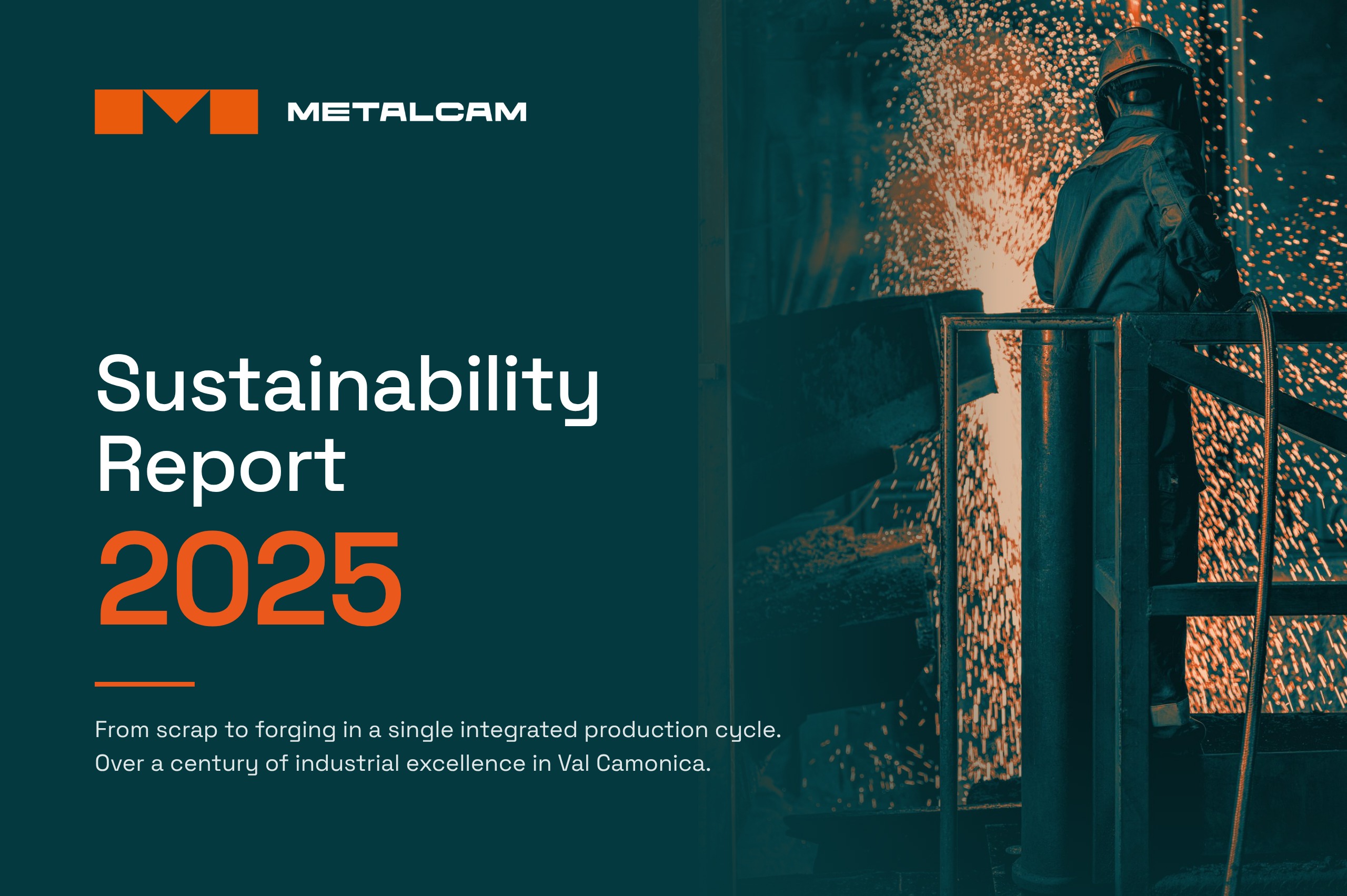
13th October 2026: the Board of Directors of Metalcam S.p.A. approves the Sustainability Report for the 2025 financial year, putting on paper the company’s path towards more sustainable, efficient and safe steelmaking.
Sustainability as an industrial issue
For heavy industry, sustainability now shapes costs, market access and relationships with customers, investors and local communities. In steelmaking it means measuring the energy used for every tonne produced, managing emissions within an increasingly demanding regulatory framework – starting with the EU Emissions Trading System (EU ETS) and the gradual phase-out of free allowances – and ensuring safe working conditions for people. This is where decarbonisation of the steel industry begins: with reliable data and strategic investment.
Against this backdrop, Metalcam, a company specialized in the production of custom-designed steel forgings based in Breno (Brescia, Italy), is presenting its first Sustainability Report, covering the 2025 financial year.
What the Sustainability Report contains
The report has been prepared on a voluntary basis with reference to the European Sustainability Reporting Standards (ESRS), in the amended version published in December 2025. It is built on a Double Materiality Assessment carried out in 2025, which also involved selected customers and suppliers, and which considers both the company’s impacts on people and the environment and the effects of ESG factors on its financial position. The assessment identified 14 material topics – from climate to occupational safety, from the circular economy to business conduct – which form the backbone of the entire report.
Environment: a steel mill that measures, recovers and reduces
Metalcam steel is made from scrap melted in an electric arc furnace, the steelmaking route with the lowest energy and emissions intensity per tonne. It is a long-standing vocation: back in 1920, the Breno plant was nicknamed “the University of the electric furnace”.
In 2025, specific natural gas consumption fell to 78.6 m³ per tonne produced (−4.0% compared with 2024), and specific electricity consumption in the melt shop fell to 868 kWh/t (−1.7%). Scrap accounts for 87% of input materials, and 30-35% of the scrap melted comes from in-house processing and is fed back into the production cycle. Residual heat from flue gases supplies district heating.
Social: people at the centre
Metalcam employs 182 people, 100% of them on permanent contracts. The recordable injury rate fell from 32.1 to 19.4 per million hours worked (−40%). Average training hours rose from 9.6 to 15.3 (+59.3%), driven by a new training plan extended to technical skills, soft skills and ESG topics. At the end of 2025, a pilot project was launched to test a new corporate welfare platform. Finally, the company carried out its first Employee Climate Survey, with a participation rate of 84%.
Metalcam’s ties with Val Camonica and the wider Brescia area are expressed first and foremost through the economic activity it generates, supported by its focus on local suppliers, which account for around 30% of the Company’s purchases.
The tradition of social responsibility of the reference families – carried forward through the work of the Company and its shareholder Carlo Tassara S.p.A., as well as through Fondazione Tassara, the philanthropic foundation established by Romain Zaleski in 2008 – has made it possible to support outstanding cultural, educational and sporting initiatives in the area. These include partnerships with local technical schools, Accademia Arte e Vita, Teatro delle Ali in Breno, Fondazione Teatro Grande in Brescia, USD Breno, Fondazione Scuola Cattolica di Valle Camonica and MITA – the International Museum of Antique Carpets.
Results already achieved
- 99.9% of waste sent for recovery: only 4 tonnes went to landfill, down from 15 in 2024.
- ASME III Material Organization certification for nuclear applications, obtained at the end of 2025.
- Unadjusted¹ gender pay gap reduced from 6.0% to 4.0%.
- Employee turnover down from 9.7% to 6.0%.
- Recordable injury rate down 40% compared with 2024.
The report is also clear about what remains to be done. In line with higher production volumes, total energy consumption rose by 9% and direct emissions (Scope 1) by 8%, reaching 16,212 tCO₂eq, 97% of which are covered by the EU ETS. This is why efficiency per tonne is the metric Metalcam uses to measure its progress.
Upcoming targets include
- Achieving ISO 14001 certification by 2026.
- Completing technical assessments of auxiliary plants in 2026, to increase heat recovery and tap an estimated potential of around 13,000 Sm³/year of natural gas currently unused.
- Installing free drinking water dispensers in hot-work departments.
- Completing the renovation of the historic building opposite the melt shop to create new spaces for employees, including a uniform laundry service, new changing rooms and an in-house training room.
- Developing an education support plan for employees’ children, extending the C.R.A.L. scholarship programme.
- Updating training on the Legislative Decree 231/2001 Model in 2026.
The report is designed to evolve: each edition will account for new initiatives and the results achieved. For more than a century, Metalcam has turned scrap into custom-designed forged components in special steels for oil & gas, energy, mechanical engineering and shipbuilding; today it is choosing to measure its own impact with the same precision.